
Traditional SEO Is Dying: What’s Next
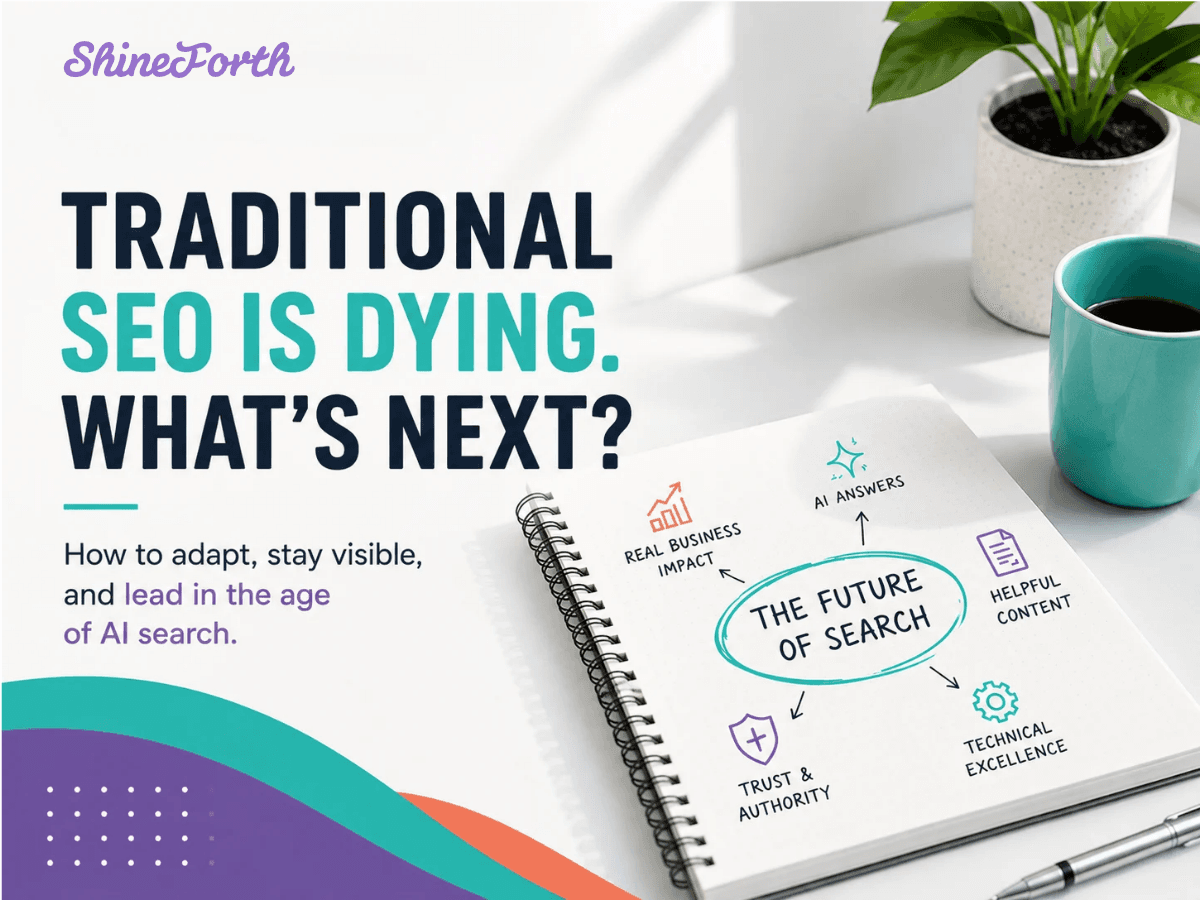
For years, search engine optimization followed a relatively predictable formula. Research the right keywords, create content around those terms, optimize titles and metadata, build backlinks, and work your way toward the top of Google.
That approach is changing quickly.
Traditional SEO is not disappearing completely, but the version of SEO built primarily around keywords, rankings, and blue links is losing its position as the center of digital discovery. Search engines now generate answers directly. AI assistants can research products, compare companies, summarize articles, and recommend resources without requiring users to browse through a traditional search results page.
For businesses, the goal can no longer be simply "How do we rank first on Google?"
The better question is: "How do we become a trusted source wherever people and AI systems are looking for answers?"
At ShineForth, we see this shift as an opportunity. Companies that build strong technical foundations, publish genuinely useful information, and make their expertise easy for both people and intelligent systems to understand can position themselves for the next generation of search.
Search Is Becoming an Answer Engine
Google search results have been evolving for years, but generative AI has accelerated that transformation.
AI Overviews and other AI-powered search experiences can synthesize information from multiple sources and provide an answer directly on the results page. Google has also continued expanding AI Mode and other generative search capabilities.
Users are adapting to this behavior. According to Pew Research Center, 60% of U.S. adults surveyed in February 2026 said they read AI summaries at the top of search results.
That shift has important consequences for website traffic.
Pew's analysis of Google browsing behavior found that users clicked a traditional search result on 8% of visits when an AI summary appeared, compared with 15% when one did not. Links cited directly within AI summaries received clicks in just 1% of visits studied.
In other words, earning a high ranking does not necessarily guarantee the traffic it once did.
SEO Is Not Dead, but the Definition Is Changing
It would be a mistake to abandon SEO altogether.
Google itself continues to emphasize that established SEO fundamentals remain relevant to its generative AI search experiences. Technical accessibility, helpful content, crawlability, structured information, and a strong user experience still matter.
What is becoming less effective is treating SEO as a checklist designed primarily for an algorithm.
Publishing dozens of nearly identical keyword-targeted articles, stuffing pages with search phrases, or creating generic content simply to capture search volume provides less of a competitive advantage when an AI system can summarize dozens of similar pages almost instantly.
The future of search favors content that provides something worth referencing.
1. Create Content AI Cannot Easily Commoditize
Generic content has become incredibly easy to produce. That means businesses need to give search engines, AI systems, and customers information they cannot find everywhere else.
Google specifically recommends creating unique, non-commodity content that provides real value to visitors as search becomes increasingly AI-powered.
Instead of publishing another article explaining "five benefits of cloud computing," share what your team actually knows.
That could include original research, project lessons, expert perspectives, proprietary data, case studies, implementation guidance, benchmarks, customer questions, or insights gathered through years of experience.
Your expertise becomes the differentiator.
2. Start Thinking About GEO Alongside SEO
Businesses should increasingly think beyond traditional Search Engine Optimization and consider Generative Engine Optimization (GEO).
GEO focuses on making your organization and its content easier for AI-powered systems to discover, understand, trust, and potentially reference when generating answers.
This does not mean creating content exclusively for AI. In many ways, it means doing the fundamentals better.
Clearly explain who you are, what you do, who you serve, and what expertise you have. Create pages that directly answer meaningful customer questions. Use logical headings and page structures. Keep important business information consistent across the web.
The easier your expertise is to understand, the easier it becomes for both humans and machines to use it.
3. Structure Your Website Around Questions, Not Just Keywords
Traditional SEO strategies often begin with a keyword.
Modern search strategies should also begin with a question.
Think about what a potential customer would actually ask Google, ChatGPT, Gemini, or another AI assistant.
Instead of targeting only a phrase such as "custom software development," consider questions such as:
- How much does custom software development cost?
- Should we modernize our existing application or rebuild it?
- When should a business move from spreadsheets to a custom application?
- How do you choose between custom software and SaaS?
- How can AI be integrated into an existing business application?
These questions better reflect how people interact with conversational search tools.
Create clear, authoritative answers and then support them with deeper resources.
4. Build a Strong Technical Foundation
The rise of AI does not make technical SEO irrelevant. It makes a well-structured website even more important.
Search engines and intelligent systems need to access and interpret your content before they can use it effectively.
Businesses should continue paying attention to site performance, mobile usability, crawlability, internal linking, descriptive page titles, structured data where appropriate, accessible content, and clear site architecture.
Google's guidance for succeeding in AI search continues to emphasize many of these established SEO practices.
Your website should make it easy to understand the relationships between your company, services, expertise, locations, people, and resources.
5. Expand Beyond Written Content
Search is becoming increasingly multimodal.
People can search with text, images, voice, and video, while AI systems can interpret information across several formats. Google recommends supporting written content with relevant high-quality images and videos as part of preparing for AI-powered search experiences.
A strong search strategy may now include articles, videos, diagrams, FAQs, case studies, webinars, comparison guides, original graphics, and other useful resources.
The objective is not simply to publish more.
It is to become the best resource for the topics that matter to your customers.
6. Build Your Brand Across the Web
Discovery is no longer confined to your website.
AI systems may encounter information about a company across websites, industry publications, directories, social platforms, videos, forums, reviews, and other sources.
That makes broader digital authority increasingly valuable.
Companies should invest in thought leadership, digital PR, partnerships, relevant industry directories, customer reviews, social content, expert contributions, and other credible mentions across the web.
Your website remains the foundation, but your overall digital presence helps establish who you are.
7. Stop Measuring Success by Rankings Alone
For years, marketing reports have centered on rankings, impressions, organic sessions, and clicks.
Those metrics still matter, but they no longer tell the entire story.
As AI answers more questions without requiring a website visit, businesses should broaden how they measure organic visibility.
Look at qualified organic leads, branded searches, conversions, engagement, referral sources, assisted conversions, mentions, and visibility within AI-generated answers alongside traditional rankings.
Google has similarly encouraged site owners to consider the value and quality of visits rather than focusing exclusively on click volume as AI search evolves.
The question is not simply whether someone clicked your article.
The question is whether your digital presence helped move that person toward trusting and choosing your business.
The Future Is Search Everywhere Optimization
Traditional SEO is not going to disappear overnight. Google will continue sending meaningful traffic to websites, and businesses should continue following sound SEO practices.
But optimizing exclusively for ten blue links is increasingly limiting.
People are discovering businesses through Google, AI-generated summaries, conversational assistants, social platforms, video, communities, and tools that may not resemble a traditional search engine at all.
The companies that adapt will stop thinking exclusively about rankings and start thinking about discoverability, authority, and trust.
At ShineForth, we help organizations build modern websites and applications with the technical foundations needed to perform in an evolving digital landscape. From site architecture and performance to AI-ready platforms and structured content, the goal is not simply to optimize for today's search engine.
It is to build digital experiences that are ready for whatever comes next.