
Next.js 16.3: Faster Development, Smarter AI, and Better User Experiences
Building modern web applications has become more demanding than ever. Businesses expect applications to load instantly, scale effortlessly, support artificial intelligence, and deliver exceptional user experiences across every device. At the same time, development teams are under increasing pressure to deliver these capabilities more quickly without sacrificing quality or long-term maintainability.
Next.js has established itself as one of the leading frameworks for building high-performance web applications, and version 16.3 continues that momentum. While many of the updates are designed for developers, the benefits extend well beyond the development team. Faster workflows, improved application performance, and stronger AI integration ultimately translate into better products and better business outcomes.
For organizations investing in custom software, customer portals, dashboards, or AI-powered platforms, these enhancements provide another step toward building applications that are both scalable and future-ready.
AI Is Transforming Software Development
Artificial intelligence is changing the way software is built.
Rather than serving only as a code generator, today's AI tools are becoming intelligent development assistants. They help developers identify problems, recommend improvements, explain unfamiliar code, and accelerate troubleshooting throughout the development lifecycle.
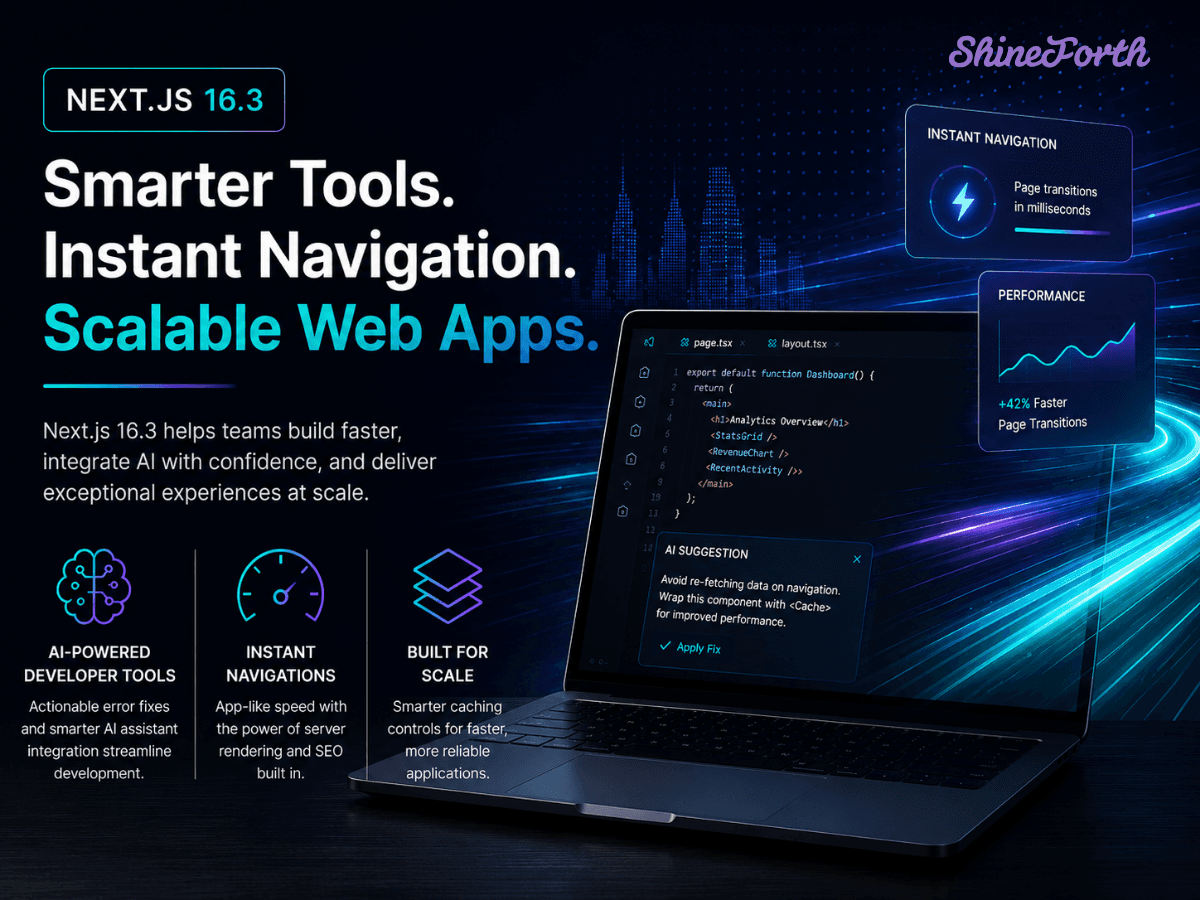
Next.js 16.3 enhances this experience by introducing more actionable error handling. Instead of displaying generic error messages, developers receive contextual guidance and suggested fixes that make diagnosing issues significantly faster. These improvements reduce time spent debugging and allow teams to focus more energy on delivering valuable features.
The release also strengthens support for AI coding assistants by improving how these tools understand project context. As AI gains a deeper understanding of an application's architecture, it can generate more relevant recommendations and provide better assistance throughout development.
While AI helps accelerate software delivery, experienced developers remain essential. Human oversight ensures applications remain secure, maintainable, and aligned with business objectives.
Faster Navigation Improves the User Experience
Performance has always been one of the defining strengths of Next.js, and version 16.3 continues to improve in this area.
One of the most notable additions is Instant Navigation, which makes moving between pages feel nearly instantaneous. Users benefit from the responsiveness typically associated with single-page applications while businesses continue to enjoy the advantages of server-side rendering, including strong search engine optimization, fast initial page loads, and improved scalability.
For customers, this creates a smoother browsing experience.
For businesses, it often leads to higher engagement, improved conversion rates, and applications that continue performing well as traffic grows.
In today's digital landscape, even small improvements in performance can have a measurable impact on user satisfaction.
Smarter Performance Through Better Caching
As applications grow, managing performance becomes increasingly complex.
Every new integration, feature, or data source introduces additional processing that can affect application speed if not managed properly.
Next.js 16.3 introduces improvements to Cache Components, giving developers more precise control over how information is stored, refreshed, and reused throughout an application. This allows frequently accessed content to remain fast while ensuring dynamic data stays current when users need it.
For organizations building dashboards, reporting platforms, eCommerce applications, or AI-powered experiences, these enhancements help deliver both speed and reliability without adding unnecessary complexity to the application architecture.
Building AI Applications Requires the Right Foundation
Many businesses are exploring artificial intelligence to improve customer experiences, automate workflows, and generate operational insights.
Successfully implementing AI, however, requires more than simply integrating a large language model.
AI-powered applications depend on responsive interfaces, efficient data retrieval, scalable infrastructure, and modern architectures capable of supporting increasingly sophisticated workloads.
Frameworks like Next.js provide the flexibility needed to support these capabilities while maintaining high performance and long-term scalability. As organizations continue expanding their AI initiatives, investing in modern development platforms becomes an important part of building sustainable technology ecosystems.
What This Means for Businesses
Technology decisions should always support broader business goals.
The improvements introduced in Next.js 16.3 are not simply about making developers more productive. They help organizations deliver applications that launch faster, respond more quickly, scale more efficiently, and adapt more easily as business needs evolve.
Applications that perform well encourage customer engagement. Efficient development workflows reduce project timelines. Modern architectures make it easier to introduce new capabilities without rebuilding existing systems.
These advantages compound over time, allowing organizations to innovate more confidently while controlling long-term maintenance costs.
How ShineForth Leverages Modern Development
At ShineForth, we continuously evaluate emerging technologies to ensure our clients benefit from practical innovation rather than short-lived trends.
Next.js has become one of our preferred frameworks because it provides an excellent balance of performance, flexibility, security, and scalability. The enhancements introduced in version 16.3 strengthen that foundation even further by improving both the developer experience and the end-user experience.
Whether we are building custom business applications, customer portals, enterprise dashboards, or AI-powered solutions, our objective remains the same: create technology that delivers measurable business value today while supporting future growth tomorrow.
Looking Ahead
Artificial intelligence and modern web technologies continue to evolve rapidly.
Organizations that adopt scalable platforms today will be better prepared to integrate new AI capabilities, respond to changing customer expectations, and remain competitive as technology advances.
Next.js 16.3 demonstrates that innovation is no longer just about adding new features. It is about helping organizations build software that is faster, smarter, and easier to maintain over the long term.
For businesses planning new applications or modernizing existing platforms, choosing the right technology foundation today can create meaningful advantages for years to come.
References
Next.js. (2025). Next.js 16.3 Release Notes.
Vercel. (2025). Next.js Documentation.