
Mid-Year Software Audits That Actually Improve Outcomes
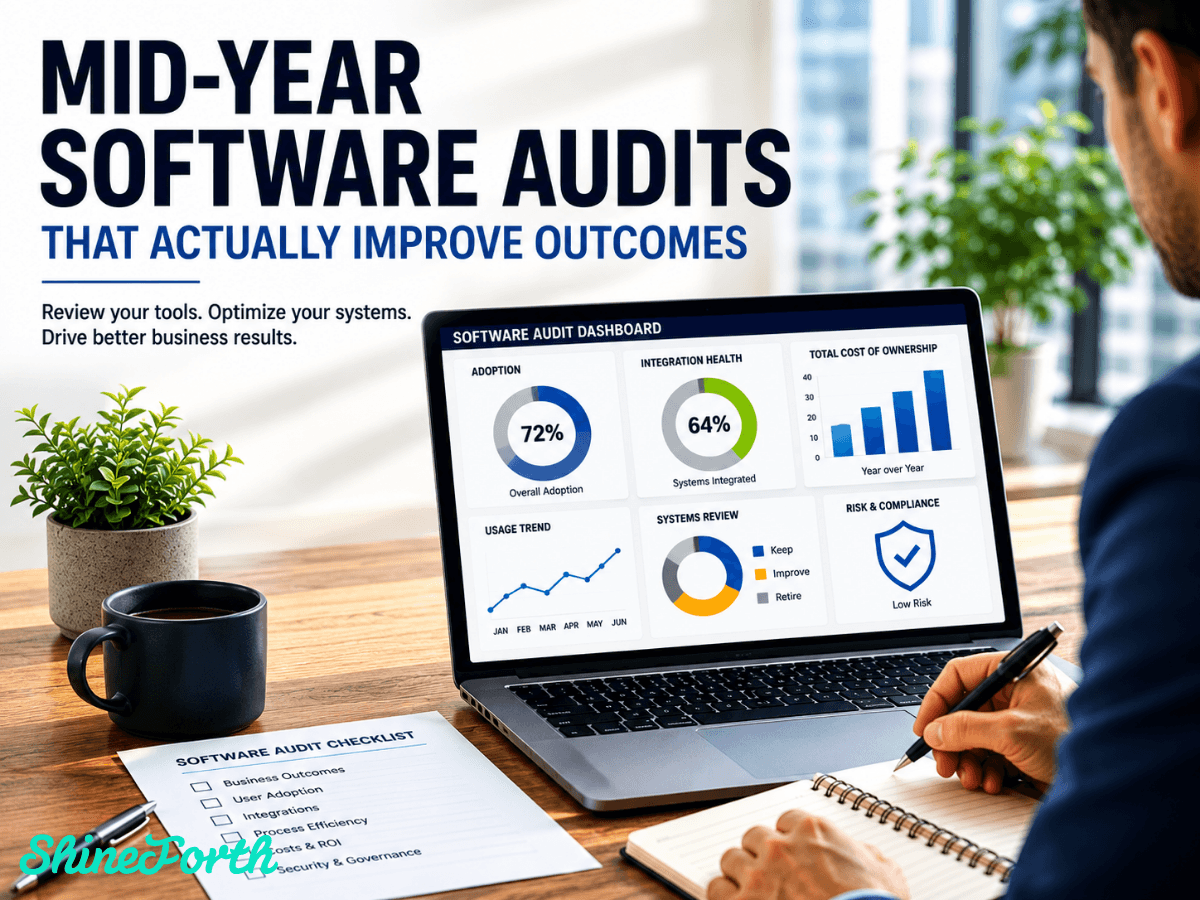
By the midpoint of the year, most organizations have a clearer picture of what's working and what isn't. Technology investments made during annual planning cycles have had time to settle into daily operations, teams have adapted their workflows, and new business challenges have emerged. This makes mid-year an ideal time to evaluate whether your software ecosystem is truly supporting business objectives.
Yet many software audits fail to deliver meaningful insights. Instead of examining how technology impacts productivity, customer experience, and operational efficiency, organizations often become distracted by feature comparisons and vendor promises. The result is a review process that generates more information than action.
A successful mid-year software audit focuses on outcomes rather than capabilities. It examines how technology fits into the realities of your organization, including team capacity, workflow efficiency, integration challenges, and long-term business goals.
Why Mid-Year Is the Best Time for a Software Audit
Waiting until year-end to evaluate technology often leaves little room to make meaningful improvements before the next budget cycle. A mid-year review provides an opportunity to identify inefficiencies, optimize existing investments, and address emerging challenges while there is still time to influence business results.
Technology environments change rapidly. New applications are introduced, processes evolve, and teams discover workarounds that may not align with the original intent of a platform. Over time, these small changes can create unnecessary complexity, increase costs, and reduce operational effectiveness.
Conducting a software audit in the middle of the year helps organizations regain visibility into their technology landscape and make informed decisions about where to focus resources moving forward.
Start With Business Outcomes, Not Software Features
One of the most common mistakes during a software audit is evaluating platforms based on what they can do rather than what they actually accomplish. Modern software solutions often come with extensive feature sets, but more functionality does not automatically translate into greater value.
Instead of asking whether a platform has the latest capabilities, organizations should assess whether it is helping employees work more effectively, improving customer experiences, and supporting strategic goals. Technology should be viewed as an enabler of business outcomes rather than an objective in itself.
When software is aligned with organizational priorities, decisions become easier. The conversation shifts from comparing features to measuring impact.
Assess Team Capacity and Adoption
Even the most powerful technology can fall short if employees struggle to use it effectively. Adoption is often a stronger indicator of software success than functionality.
During a software audit, leaders should examine how teams are interacting with existing systems. Are employees relying on the platform as intended, or have they developed alternative processes outside the system? Are valuable capabilities being overlooked because users lack training or confidence? Is the platform creating efficiencies, or has it become another administrative burden?
Understanding how people use technology provides valuable context for evaluating its effectiveness. In many cases, organizations discover that their challenges stem less from the software itself and more from gaps in adoption, training, or process design.
Look Closely at Integration Friction
Many operational inefficiencies can be traced back to disconnected systems. Organizations frequently invest in high-quality applications only to find that information does not flow smoothly between them.
When integrations are limited or unreliable, employees often compensate through manual data entry, spreadsheet exports, and duplicate processes. These workarounds consume time, increase the likelihood of errors, and make it difficult to establish a single source of truth across the organization.
A mid-year software audit should examine how data moves between systems and where friction exists. In many cases, improving integrations delivers greater business value than replacing software altogether. Eliminating manual handoffs and improving data consistency can have a significant impact on productivity and decision-making.
Understand the True Cost of Your Technology Stack
Software costs extend well beyond licensing fees. While subscription expenses are easy to identify, many organizations underestimate the hidden costs associated with implementation, customization, support, training, and ongoing maintenance.
A platform that appears cost-effective on paper may require substantial internal resources to manage. Likewise, software that reduces manual work and improves operational efficiency may provide far greater value than its subscription price suggests.
Evaluating total cost of ownership provides a more accurate understanding of technology ROI and helps organizations make better long-term decisions about their software investments.
Review Processes Alongside Technology
Technology is often blamed for challenges that actually originate in business processes. Before deciding that a platform needs to be replaced, organizations should examine whether existing workflows are creating unnecessary complexity.
Lengthy approval chains, redundant data collection, inconsistent procedures, and unclear ownership can all create inefficiencies that software alone cannot solve. In many situations, optimizing processes delivers greater improvements than implementing new technology.
A successful software audit evaluates the relationship between systems and workflows, recognizing that technology performs best when supported by efficient and well-defined processes.
Security and Governance Should Be Part of Every Audit
As organizations continue to adopt cloud applications and AI-powered tools, security and governance have become essential components of technology management. A mid-year review provides an opportunity to verify that software platforms align with organizational security standards and compliance requirements.
This includes reviewing user access controls, permission structures, data management practices, and vendor security measures. It is also an appropriate time to evaluate emerging governance requirements related to artificial intelligence and automated decision-making tools.
Addressing these areas proactively helps reduce risk while supporting future growth initiatives.
Optimize Before You Replace
One of the most valuable outcomes of a software audit is realizing that new software is not always the answer. Many organizations already possess the tools they need to achieve their goals. The challenge is often ensuring those tools are properly integrated, adopted, and aligned with business processes.
Before investing in additional platforms, leaders should consider whether existing systems can be optimized through improved training, better workflows, stronger integrations, or enhanced governance practices. These improvements often deliver meaningful results at a fraction of the cost and disruption associated with a full software replacement.
Final Thoughts
A mid-year software audit should provide more than a snapshot of your technology environment. It should reveal how effectively your systems support the people, processes, and goals that drive your business forward.
By focusing on business outcomes, user adoption, integration challenges, and operational efficiency, organizations can move beyond feature comparisons and make technology decisions that create measurable value. The objective is not simply to have more software. It is to build a technology ecosystem that helps your organization operate smarter, scale more effectively, and adapt confidently to future opportunities.