
The Growing Gap Between Technology Capability & Organizational Readiness
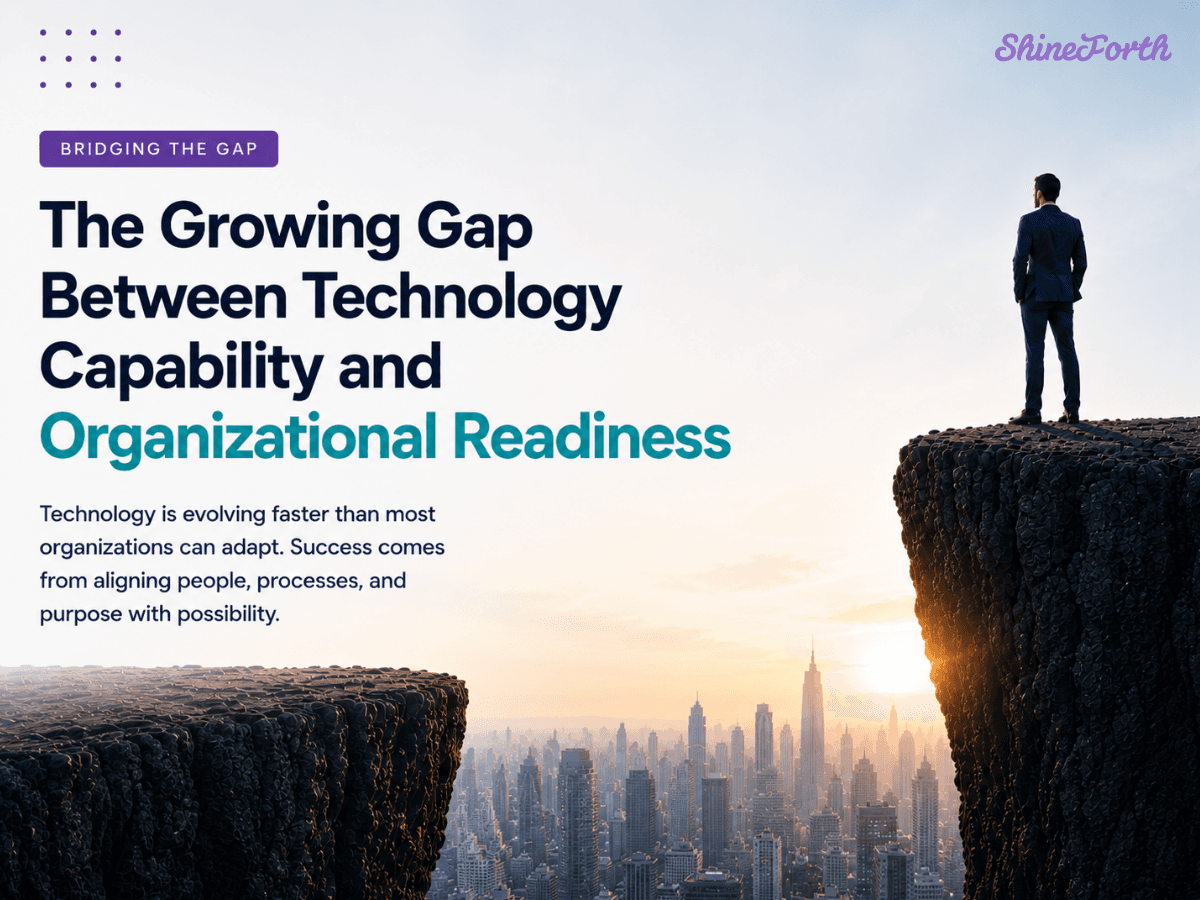
Technology has never been more powerful. Artificial intelligence can automate complex tasks, cloud platforms can scale on demand, and modern software ecosystems can connect nearly every aspect of a business. Yet despite these advancements, many organizations struggle to realize the full value of their technology investments.
The challenge is rarely the technology itself.
More often, the gap exists between what technology is capable of doing and what an organization is prepared to adopt, manage, and sustain. As businesses continue to invest in digital transformation, this gap is becoming one of the most significant barriers to achieving meaningful results.
Technology Is Moving Faster Than Organizations
Over the past several years, technology innovation has accelerated at an unprecedented pace. New AI tools emerge almost weekly, software vendors continuously introduce new features, and organizations are presented with a growing number of opportunities to improve operations.
While these innovations create exciting possibilities, they also create pressure.
Business leaders often feel compelled to adopt new technologies quickly to remain competitive. However, successful implementation requires more than purchasing software or deploying a new platform. It requires organizational readiness.
Readiness includes employee training, process alignment, data quality, governance, change management, and leadership support. Without these foundational elements, even the most advanced technology can struggle to deliver measurable business value.
The Symptoms of Organizational Readiness Gaps
Many organizations recognize that they are not achieving the outcomes they expected from technology investments, but they often misdiagnose the problem.
Common symptoms include:
- Low user adoption
- Inconsistent business processes
- Poor data quality
- Duplicate manual work
- Employee frustration
- Limited visibility across departments
- Difficulty measuring return on investment
When these issues occur, organizations frequently assume they need additional software. In reality, the root cause is often a lack of preparation for the technology already in place.
Adding more tools to an environment that lacks readiness can increase complexity without improving results.
Why Change Management Matters More Than Ever
Technology projects are often viewed as technical initiatives, but their success depends heavily on people.
Employees must understand how new systems support their work. Leaders must communicate the purpose behind technology investments. Teams need training, documentation, and ongoing support to build confidence and competence.
Without a clear change management strategy, organizations may encounter resistance, confusion, and inconsistent adoption.
This is particularly true with AI initiatives. While AI offers significant opportunities for efficiency and innovation, employees need guidance on how these tools should be used, where human oversight remains necessary, and how success will be measured.
Organizations that prioritize people alongside technology are often the ones that achieve the strongest outcomes.
Process Maturity Is a Critical Foundation
One of the most common mistakes businesses make is attempting to automate inefficient processes.
Technology can accelerate operations, but it cannot fix poorly designed workflows on its own. If a process is unclear, inconsistent, or dependent on manual workarounds, introducing new software may simply automate existing inefficiencies.
Before implementing new technologies, organizations should evaluate how work is currently performed, identify bottlenecks, and establish standardized processes.
When technology is built upon mature processes, adoption becomes easier and business value becomes easier to measure.
Data Readiness Is Often Overlooked
Modern software platforms and AI systems rely heavily on accurate, accessible, and well-governed data.
Unfortunately, many organizations discover data challenges only after implementation begins. Information may exist in multiple systems, follow inconsistent standards, or contain significant quality issues.
Without trusted data, reporting becomes unreliable, automation produces inconsistent results, and AI tools struggle to generate meaningful insights.
Organizations that invest in data governance and integration before pursuing advanced technology initiatives often achieve faster and more sustainable returns.
Closing the Gap Between Capability and Readiness
The organizations achieving the greatest success with technology are not necessarily those adopting the newest tools first.
They are the organizations that align technology with people, processes, and business objectives. They understand that successful transformation requires preparation, communication, and ongoing improvement.
At ShineForth, we frequently help organizations evaluate not only their technology environments but also the operational factors that influence adoption and long-term success. Whether implementing new software, modernizing existing systems, or exploring AI opportunities, the goal is not simply to deploy technology. The goal is to ensure the organization is prepared to use that technology effectively.
As technology capabilities continue to advance, organizational readiness will increasingly become the true differentiator. Businesses that invest in both will be better positioned to adapt, compete, and grow in an increasingly digital world.