
AI Agents Are Starting to Talk to Each Other. Here's Why That Matters
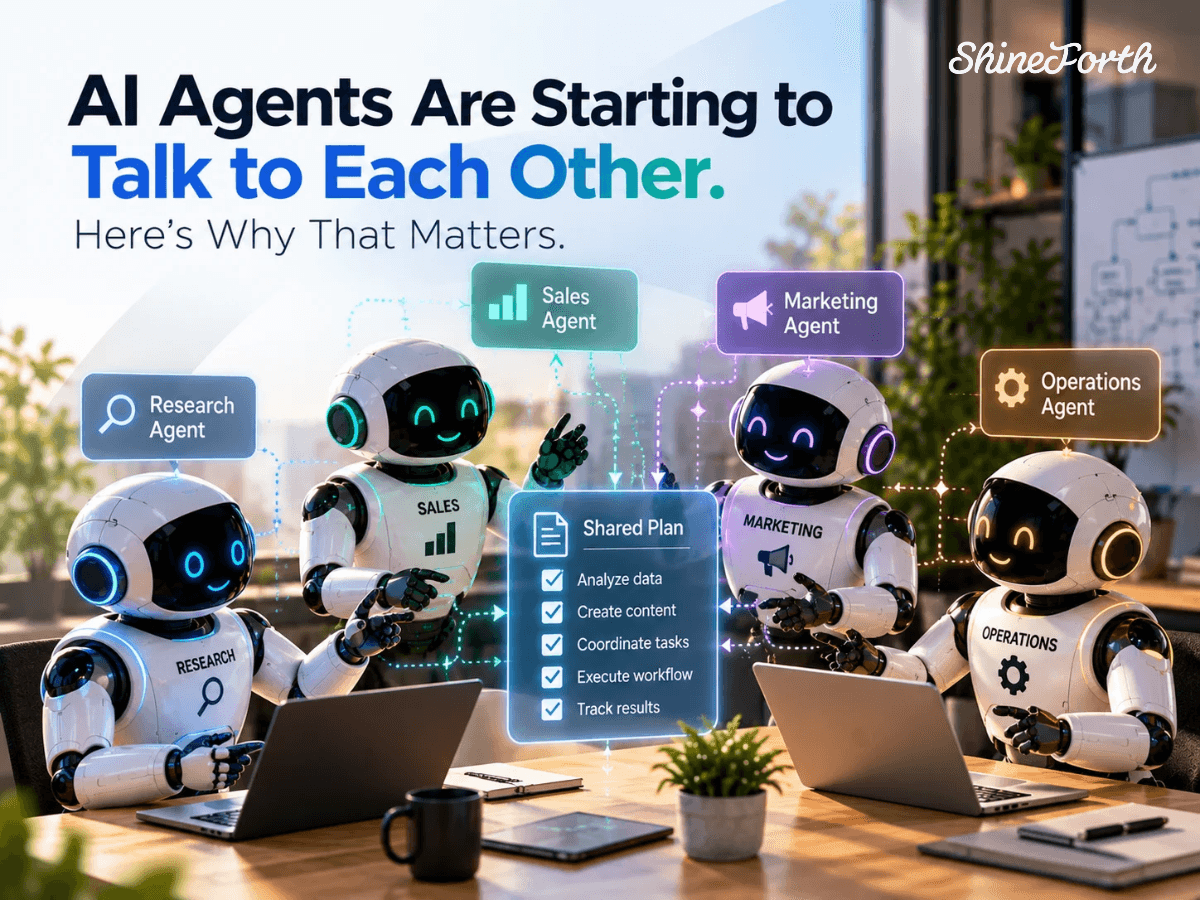
Artificial intelligence is evolving beyond simple conversations between humans and chatbots. Until recently, most AI tools operated independently, responding to prompts, generating content, or completing individual tasks. Now, a new shift is emerging: AI agents are beginning to communicate, collaborate, and coordinate tasks with one another.
This development could fundamentally change how businesses use AI. Rather than relying on a single AI assistant to complete a task, organizations can create networks of specialized AI agents that work together to accomplish more complex goals.
But what does it actually mean for AI agents to communicate, and why should businesses pay attention?
From AI Assistants to AI Teams
Most businesses are familiar with traditional AI assistants. You ask a question, provide instructions, and receive a response.
AI agents take this a step further. They can be designed to access information, use connected tools, follow workflows, and perform specific tasks with varying levels of independence.
Now imagine multiple agents working together, each responsible for a different part of a process.
For example, a business could use:
- A Sales Agent to identify potential customers and gather relevant information.
- A Research Agent to analyze market trends and competitor activity.
- A Marketing Agent to create personalized outreach content.
- A Reporting Agent to track results and summarize performance.
Instead of requiring an employee to manually transfer information between each tool, these agents could share relevant data, coordinate their actions, and move a workflow forward.
This approach is known as a multi-agent system, and it represents a significant step toward more connected AI-powered operations.
How Do AI Agents Communicate?
AI agents don't communicate exactly like humans. Instead, they exchange structured information, requests, and results through software connections and established communication protocols.
Emerging standards such as Agent2Agent (A2A) are being developed to help agents built on different platforms communicate and collaborate.
Another important technology, Model Context Protocol (MCP), helps AI applications connect with external tools, databases, and business systems. While MCP focuses primarily on connecting AI to tools and information, A2A focuses on communication between agents.
Together, these technologies are helping create an environment where AI systems can interact with more of the software businesses already rely on.
For organizations, this could mean fewer disconnected AI tools and more coordinated workflows across departments and platforms.
What Could This Look Like in a Real Business?
Consider a company managing customer orders across multiple locations.
Today, employees might need to monitor incoming orders, check inventory, coordinate shipping, update customer records, and communicate delivery timelines across several different systems.
With a coordinated network of AI agents, portions of this process could become automated.
An order management agent could detect a new order and request an inventory check from another agent. If inventory is available, a fulfillment agent could prepare the next step in the shipping process. A customer service agent could then draft or send an appropriate update based on approved business rules.
If an issue arises, such as insufficient inventory or an unexpected shipping delay, the workflow could route the exception to an employee for review.
Rather than operating as isolated tools, these agents would work together toward a shared business objective.
The potential benefit isn't simply completing individual tasks faster. It's reducing the manual coordination required to move information and work between systems.
Why This Matters for Businesses
As AI agents become more connected, businesses may discover opportunities that extend beyond basic chatbots and content generation.
1. More Complex Workflow Automation
Traditional automation generally follows predefined rules and sequences. Multi-agent systems can introduce additional flexibility by allowing specialized agents to analyze information, make recommendations, and coordinate next steps.
This could help businesses manage workflows that involve multiple departments, tools, or decisions.
2. Better Use of Existing Business Data
Many organizations have valuable information scattered across CRMs, project management platforms, documents, and internal databases.
Connected AI agents could help retrieve and use this information across different workflows, reducing the need for employees to search multiple systems manually.
However, successful implementation still depends on reliable integrations, accurate data, and appropriate access permissions.
3. Greater Operational Efficiency
When agents can exchange information and complete approved tasks, employees may spend less time transferring data, preparing routine updates, or coordinating repetitive processes.
This creates opportunities for teams to focus on customer relationships, strategic decisions, and work requiring human expertise.
4. More Scalable Business Processes
As organizations grow, operational complexity often increases. Processes that work with a handful of employees or locations may become difficult to manage across larger teams.
Well-designed multi-agent workflows could help businesses handle growing workloads without requiring every additional task to be completed manually.
The Challenge: More AI Doesn't Automatically Mean Better AI
While the possibilities are exciting, connecting multiple AI agents introduces new technical and operational challenges.
When agents communicate and act on information from other systems, businesses need to consider several important questions.
Security and permissions: What information can each agent access, and what actions is it authorized to perform?
Accuracy and reliability: How can organizations prevent incorrect information from being passed between agents and influencing subsequent decisions?
Accountability: Who is responsible when an automated workflow makes a mistake or takes an unexpected action?
Monitoring and oversight: How can employees understand what agents are doing, review their decisions, and intervene when necessary?
Cost and complexity: Does coordinating multiple agents actually improve efficiency, or does it introduce unnecessary processing, maintenance, and operational expenses?
These considerations are particularly important when AI systems interact with sensitive information, financial transactions, or customer-facing processes.
Multi-agent systems are not automatically the right solution for every workflow. In many cases, a single AI agent or traditional software integration may be simpler, more reliable, and more cost-effective.
The goal should always be to solve a business problem, not introduce additional technology simply because it's available.
Preparing for a More Connected AI Future
Businesses don't need to deploy a network of AI agents tomorrow to begin preparing for this shift.
A practical starting point is understanding how information moves throughout the organization.
Where are employees manually transferring information between systems? Which processes require repetitive coordination? What business knowledge is difficult to access? And where could automation provide measurable value?
Answering these questions can help identify opportunities for AI agents, integrations, and workflow improvements.
It also establishes the foundation needed for more advanced AI capabilities as the technology continues to mature.
The Future of AI Is Collaboration
The next chapter of artificial intelligence may be defined less by what individual AI models can do and more by how effectively they work together.
As communication standards evolve and business systems become increasingly connected, AI agents could move from standalone assistants to coordinated participants in everyday operations.
For businesses, the opportunity is significant. But realizing that potential will require more than powerful AI models. It will require thoughtful system architecture, secure integrations, reliable workflows, and clear human oversight.
At ShineForth, we help businesses connect technology, streamline operations, and build custom software solutions designed around their unique needs. As AI continues to evolve, we're exploring how these emerging capabilities can create practical value for the organizations we serve.
Interested in exploring how connected AI systems could support your business? Connect with ShineForth to discuss the possibilities.